If you run a CRM, you’re probably not getting nearly enough from it. The problem isn’t the software — it’s the time it takes to keep up. Agentic AI is starting to change that.
If you run a CRM, you already know the feeling: the system could be doing more, but you can’t find the hours to make it happen. The data bears it out. On crm.org’s compilation of industry research, 23% of users cite manual data entry as a major obstacle and 17% struggle with tool integration. And according to Validity’s State of CRM Data Management 2025 — a survey of 602 CRM users across the US, UK, and Australia — employees spend an average of 13 hours a week just hunting for information that’s supposed to be in the system.
That’s not a software problem. It’s not a training problem. It’s a time problem.
When you’re running a small business, the CRM is almost always the thing that gets maintained when there’s a moment to breathe — which means it doesn’t get maintained much at all. Notes go unfiled. Contacts go stale. The follow-up that should have happened Tuesday didn’t, because Thursday’s proposal took the whole week. You know the system could be working harder. You just haven’t had the hours to make it happen.
That gap — between what the CRM is supposed to do and what actually gets done — is exactly where agentic AI is starting to make a real difference.
And if you don’t have a CRM yet, getting one up and running is easier with agentic help — and can add real firepower to a small business.
What “agentic” actually means here
The word gets used a lot right now. For the purposes of this piece, it means something specific: AI that does things rather than just answers questions. Not a chatbot you interrogate. A system that can access your CRM data, pull what you need, draft what you ask for, and flag what you haven’t noticed — without you needing to construct a query every time.
That shift matters for a small business because the problem usually isn’t that owners don’t know what they need from their CRM. It’s that getting it out requires time they don’t have.
Your data is probably messy. That’s fine
If you’ve looked into AI and CRM, you’ve probably seen alarming statistics about data quality. The Validity research is worth taking seriously: 76% of CRM users say less than half of their organization’s CRM data is accurate and complete, and 45% say their data isn’t prepared for AI.
If you’re recognizing your own CRM in those numbers, you’re in the majority. The cause is almost always the same: data gets entered inconsistently when people are busy, contacts go stale because nobody has bandwidth to update them, and the system drifts gradually from reality. It’s not negligence. It’s a small business running at capacity.
The good news is that this is a solvable problem — and AI helps solve it. Enrichment tools like Apollo.io can auto-populate and update stale contact records from external sources. An agent connected to your CRM can flag records it can’t find good information on and prompt your team to fill in what’s missing. The goal isn’t a perfect database before you start. It’s using AI to build better habits going forward, so the system gets more useful over time rather than less.
Don’t let an imperfect database stop you from starting.
How we think about closing the gap
At Kynetyk, we use a framework for thinking about how small businesses can move from “CRM I’m underusing” to “commercial process that actually runs.” Three tiers, each with a different investment level and return.
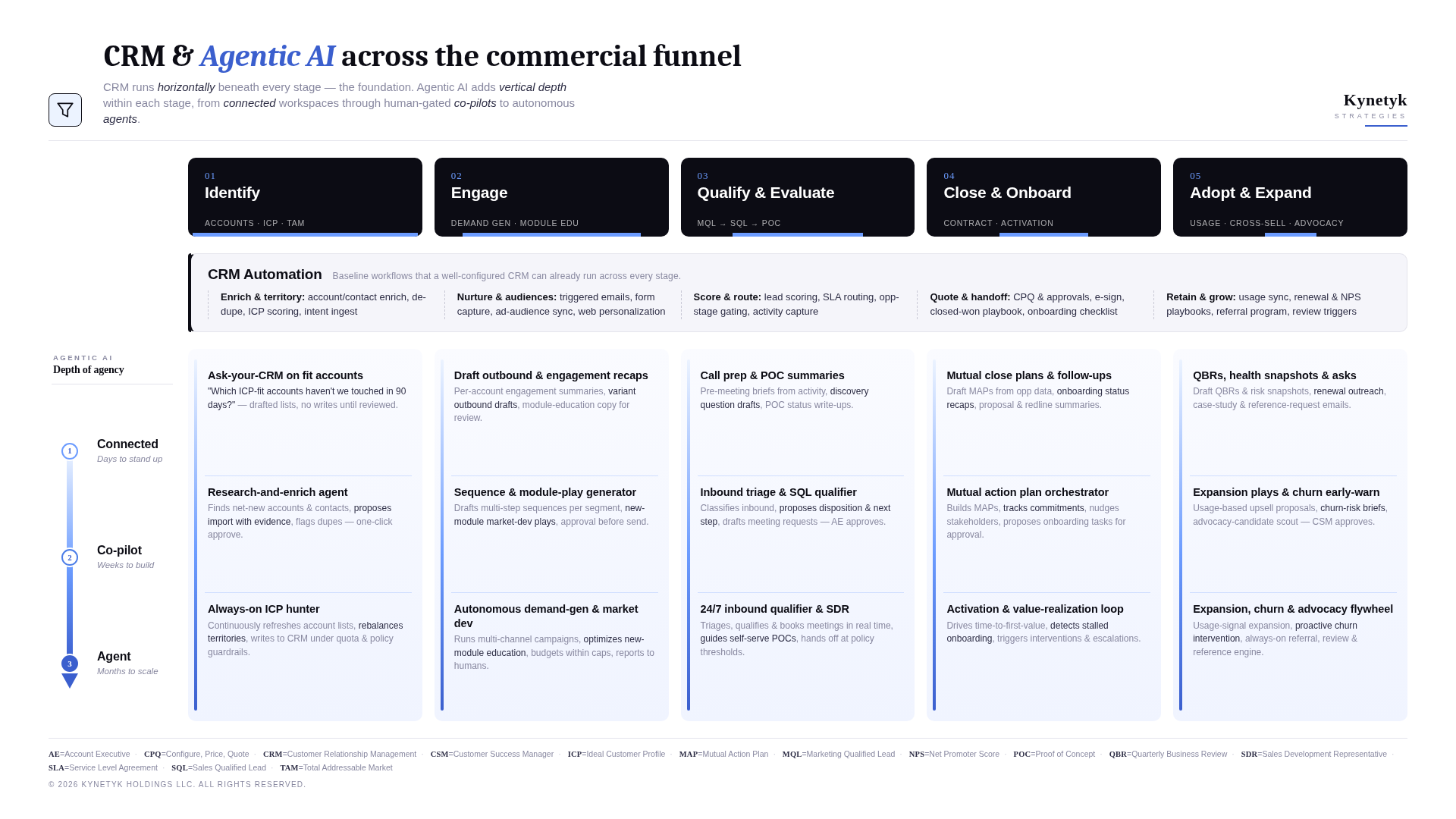
Where to start? Get connected
Getting connected is where to start — and for many businesses, where it makes sense to stay for a while. A Connected setup means your AI workspace has live access to your CRM through an MCP connector. HubSpot (GA as of April 2026), Attio, Salesforce, and Zoho all ship official MCP servers today; for other CRMs, community implementations are widely available on GitHub.
What this gives you is deceptively simple: you can ask questions of your CRM in plain language and get real answers. “Which accounts haven’t had activity in 60 days?” “What does my pipeline look like this quarter?” “Draft follow-ups for the three proposals I sent last week.” No query builder. No report template. Just the information you need, when you need it, in the form you can actually use.
Getting to Connected takes days, not weeks. It doesn’t require rebuilding anything.
Learn what matters and integrate agentic “copilots”
Co-pilot is the next step — an agent that doesn’t just answer but proposes. It drafts outbound sequences for your review before anything gets sent. It classifies inbound leads and suggests next steps for approval. It builds a mutual action plan from your notes and flags what’s slipping. The key word at this tier is approval: the agent proposes, a human decides. This is worth building selectively — in the parts of your commercial process where the friction is highest, not everywhere at once.
When full autonoomy makes sense
Agent is the fully autonomous end: always-on account research, 24/7 inbound qualification, proactive churn intervention. Real, and getting more accessible. But also genuinely a months-to-scale investment, and not where most small businesses need to begin.
The important thing about this framework isn’t the progression — it’s that it’s a map, not a prescription. Not every business needs an autonomous content drafter. Not every business needs AI-powered outbound sequences. The question to start with is simple: where does time actually disappear in your commercial process? Find that. Get Connected. Learn what the agent can do for you there. Then decide whether going deeper makes sense — and where.
The timing is good
One thing that changes the calculus right now: every major CRM is building agents in. HubSpot’s Breeze agents now price by outcome — $0.50 per resolved customer conversation, $1 per qualified lead — so you pay for results rather than seats. Salesforce bundled Agentforce free into its SMB tiers in March 2026. Zoho’s Zia Agent Studio ships 700+ built-in actions across the Zoho ecosystem.
You’re not necessarily adding AI on top of your CRM. In many cases, it’s already arriving inside the system you’re paying for.
Where we come in
This is the framework we use when we work with businesses on their commercial AI strategy. It starts with a simple question: where does your CRM fall short — not because of what it can do, but because of what you haven’t had time to make it do? That’s where AI creates the most leverage. Not by replacing your commercial process, but by filling the gaps that a stretched team inevitably leaves open.
If you want to think through where to start for your business, that’s exactly what we’re here for.
Josh is co-founder of Kynetyk, where he writes about AI, builds products at the intersection of AI and human experience, and helps companies design AI strategies that actually work. Reach out at josh@kynetyk.ai.